This is great and all, but I think I’d rather play some “holy water” (physically throwing the water up into the air with my own hands).
Super Mario Sunshine, anyone?
[Via theaquapod]
This is great and all, but I think I’d rather play some “holy water” (physically throwing the water up into the air with my own hands).
Super Mario Sunshine, anyone?
[Via theaquapod]

Paranormal Activity is a movie made by Oren Peli, “an Israeli-born videogame designer with no formal film training.” He shot the entire movie in one week for $11,000.
The thriller that made its rounds at film festivals has gained a very positive buzz on the Internet, especially on social networks like Twitter and Facebook. With obvious comparisons to the 1999 horror flick The Blair Witch Project, Paranormal Activity is also shot documentary style and is based on real-time happenings. The premise is as follows: “The film follows a young couple (Katie Featherston and Micah Sloat) who, convinced they’re being haunted by spirits, set up a video camera to monitor their bedroom over the course of 20 nights.”
There are many reasons why there is so much buzz and positive critical feedback for the movie. First, it has been reported that movie-goers have literally up and left their seats during initial screenings of the movie–it’s thatterrifying. Paramount president of production Adam Goldman witnessed 35 people walk out of an early test screening. Exit interviews were performed and they revealed that people left because they simply were not enjoying the movie; it was tooscary. Second, according to EW, “once the film was brought to the attention of DreamWorks, Steven Spielberg took a copy of the DVD to his Pacific Palisades estate, watched it there, and then found his bathroom door inexplicably locked from the inside. He thought the movie was haunted!” Whether this legend is true or not, it surely sets up a great viral marketing campaign, doesn’t it?
With all of this insane amount of buzz, Paramount has decided to create even more of it with a brilliant marketing campaign: “putting the power of movie distribution in your hands.” It is up to us to go online and “demand” that Paranormal Activityopen in theatres nationwide. Up to this point the movie has had a limited release. The studio promises that once there have been one million demands the movie will officially hit all theatres, making it widely available to be seen by all. As of this writing, the movie website’s counter has reached 914,434 “demands.” So no need to worry, it’s coming. Still, do your part and contribute by demanding the movie now right here and discuss the hype with others on Twitter (“Paranormal Activity” has been a trending topic for days now).
And I will leave you with this. Moviefone’s Kevin Poloway warns: “‘Paranormal Activity’ beats out ‘Blair Witch’ in one vital field: It’s scarier. While ‘Blair Witch’ may have scared people away from the woods for a few years (like ‘Jaws’ did the water two decades earlier), who’s going to stay away from their own bedroom?” Freak out and watch the trailer below and get ready for what people are calling “the scariest movie of the decade.”
[Via EW; AOL Moviefone]
So I’m sharing it with you.
Dig the black-and-white vibe and the shading.
[Via KanyeBlog]
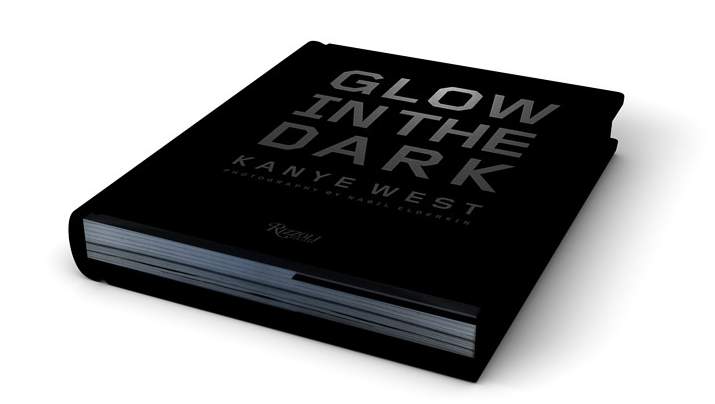
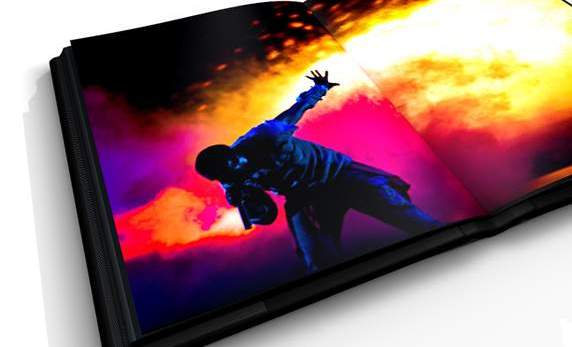
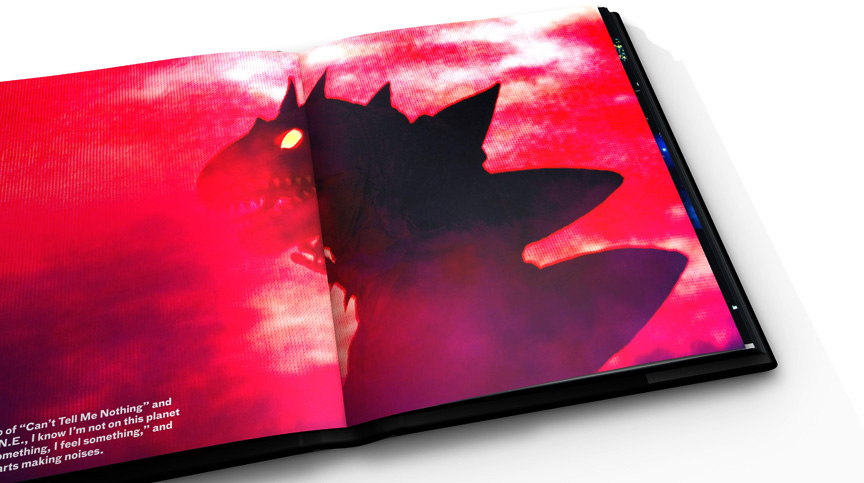
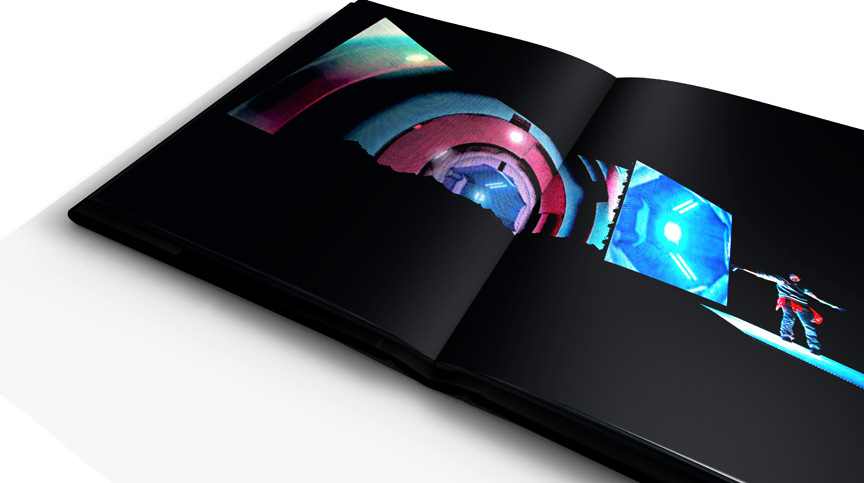
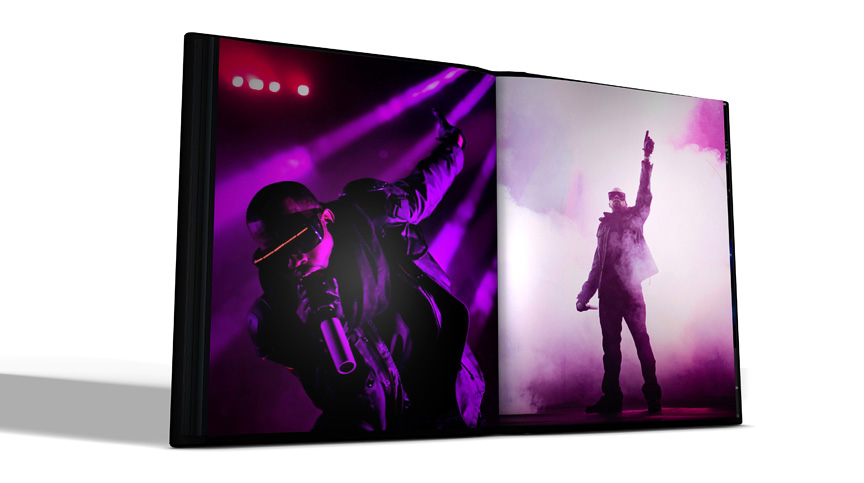
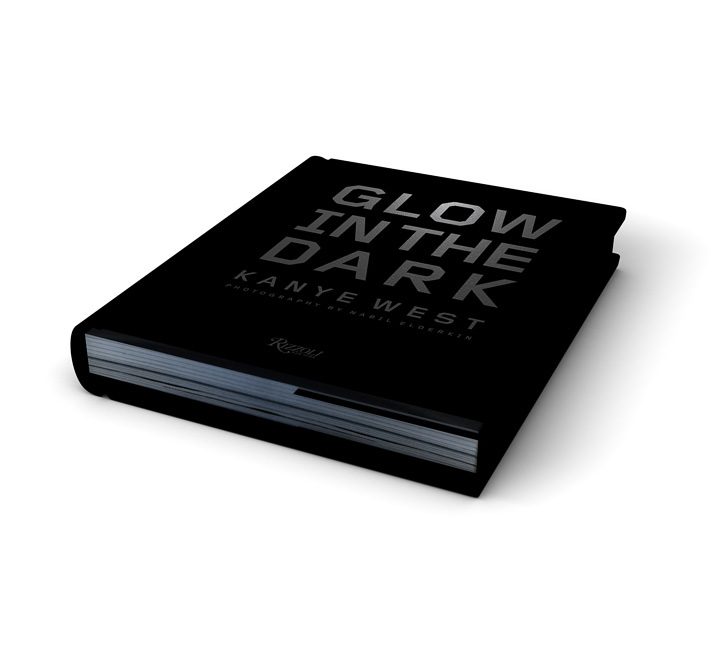
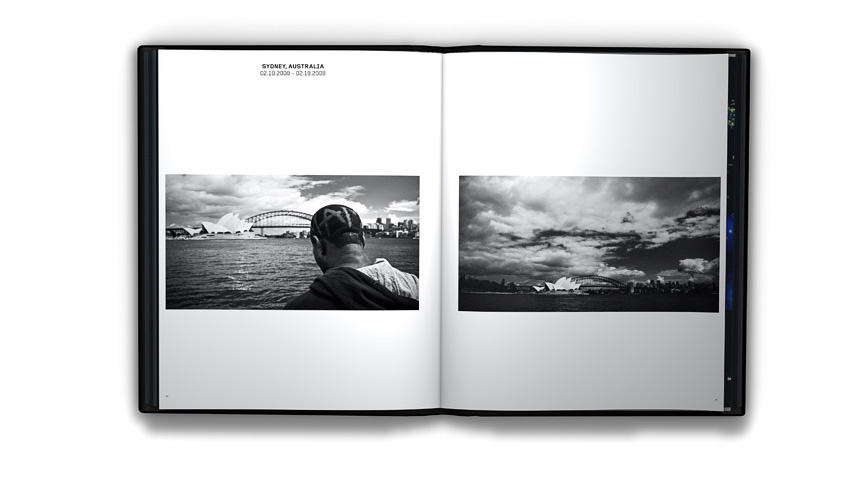
This collection of images documents Kanye West’s 2008 Glow in the Dark tour. According to Examiner: “The 288-page book provides a look at on stage performances, behind-the-scenes shots, conceptual sketches by West, costume designs, and stage models. It also includes an audio CD featuring the previously unreleased live instrumentals for “Hey Mama,” “Touch the Sky,” “Jesus Walks,” and “I Wonder,” as well as an interview with video and film director Spike Jonze.”
The book is designed by Base, published by Rizzoli, and includes pictures by Nabil Elderkin, who directed West’s “Paranoid” and “Welcome to Heartbreak” music videos. You can preorder it here or here to book for $30.
[Via KanyeBlog]
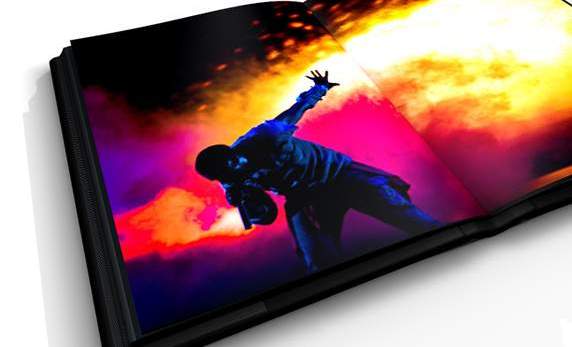
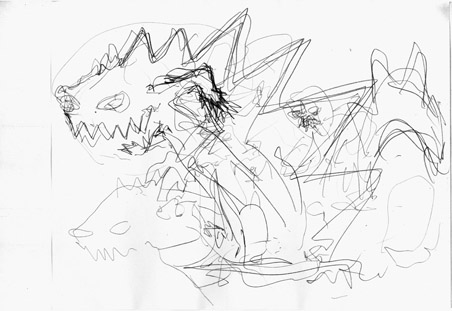


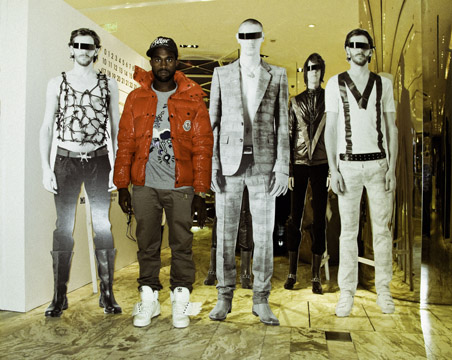
AMAZING.
[Thanks, S. Moschella]
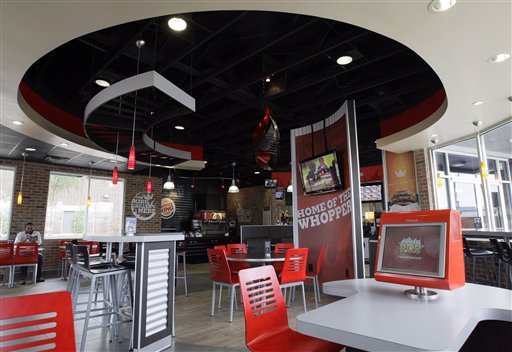
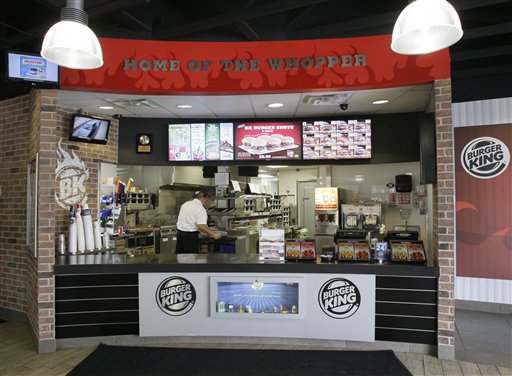
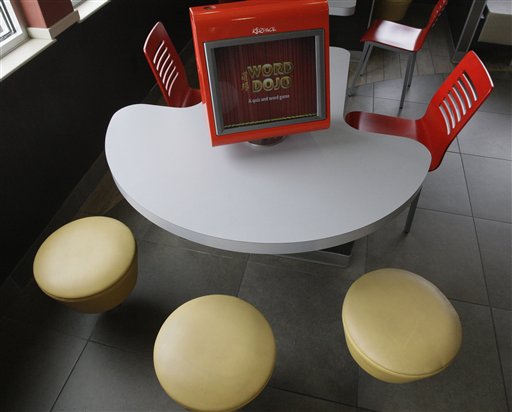
Burger King restaurants will be undergoing a significant renovation, transforming their bland, generic fast-food look into a more modern and futuristic model. According to BK Chairman and CEO John Chidsey: “I’d call it more contemporary, edgy, futuristic. It feels so much more like an upscale restaurant.” The revovation, dubbed “20/20,” will affect 12,000 BK restaurants worldwide and will cost between $300,000 to $600,000 per restaurant. The renovations include “rotating red flame chandeliers, TV-screen menus, and industrial-inspired corrugated metal and brick walls.” The redesign has already begun and has affected about 60 percent of BK locations globally. BK has stated that 75 additional restaurants will be transformed by this year’s end, but it will take years for all BK locations to be retrofitted.
Will such a drastic change in look help the BK Lounge in sales and gain an edge against its competition (re: McDonalds)? It is too early too tell. I’m just looking forward to playing around with the touch-screen menus.
Photographer Alexx Henry and his team have created this video to show how creating a “living portrait” could be created and designed in a not-so-distant future. Here Henry is photographing triathlete Chris Lieto using the RED One and the Canon 5D Mark II cameras for Outside Magazine. With the newspaper and magazine industries slowly losing the battle against the Internet for providing news, pictures, and other content, animating text and images in these mediums might be the only way to save them from extinction.
[Via Gizmodo]
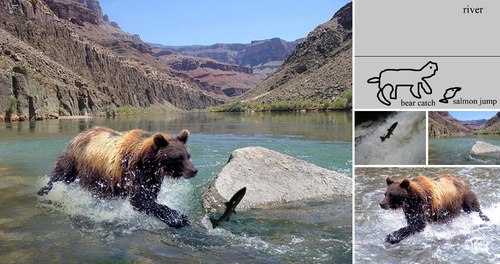
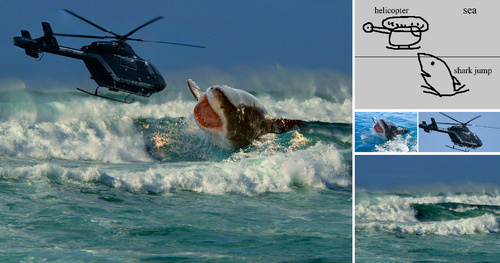
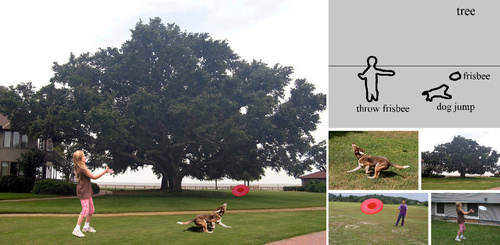
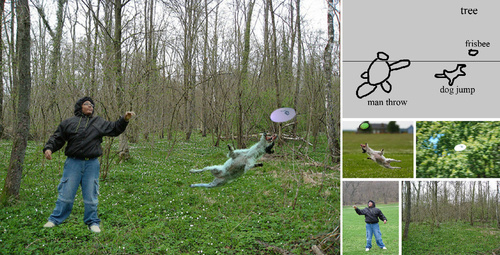
Photosketch, created by Tao Chen, Ming-Ming Cheng, Ping Tan, Ariel Shamir, and Shi-Min Hu at the Department of Computer Science and Technology at Tsinghua University and the National University of Singapore.
In simplistic terms, here’s how it works. A user draws a sketch and gives a label to each object in it (ie. bike, birds, boat). Then, the sketch is transformed into an actual picture with real object by “seamlessly stiching a background and several foreground items from photographs retrieved from the Internet in accordance with the sketch and text labels.”
Watch the video above to see the magic unfold, then check out samples in the gallery below.
[Via Gizmodo]



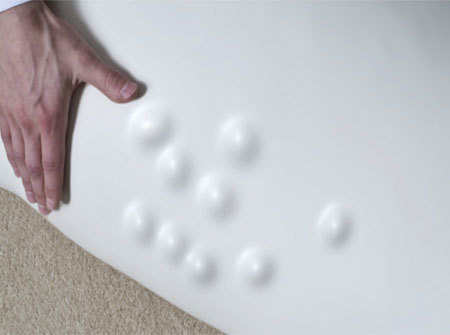
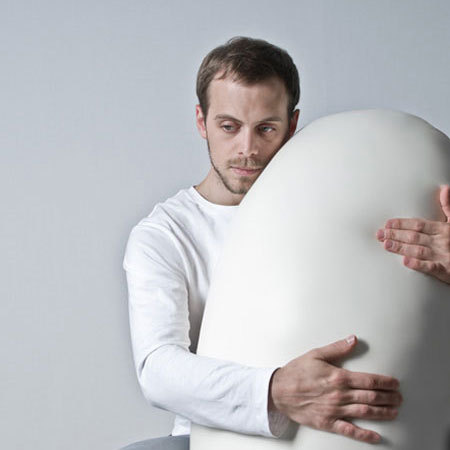
The Funktionide by German designer Stefan Ulrich.
Based on an intensive two month research (in cooperation with FESTO and the EMPA) concerning artificial muscles my work reflects upon how new technologies will change future products (and society), and the way we interact with them.
One day active materials such as electroactive polymers will drastically change the way we perceive products. Products will gain new dimensions ranging from changing tactile surfaces over active membranes to morphing shapes. Products of the future will be “alive” in a way.
[The Funkionide] is an amorph object whose intention is to provide the owner with an atmosphere of presence thus counteracting the feeling of loneliness. In the visions future people are lonely and with all the new dimensions products offer, humans will eventually turn to “robots” for emotional satisfaction.
Now if this isn’t one of the strangest things I have ever stumbled upon, I don’t know what is. So according to Ulrich, we will all live in a lonely future where only “robots” can provide the right amount of “emotion satisfaction” to give us a boost for the day. In this case, the “robot” is a giant morphing blob. Oh, how I hope such a bizzare future does not come true!
[Via Gizmodo; vimeo page]

The Rolltop, by Orkin Design, is purely a concept, an idea, a figment of imagination for now. The Rolltop features a 13-inch flexible OLED and multitouch display that can be fully ‘rolled out’ to transform into a larger 17-inch screen. It includes a detatchable stand that stores the device’s stylus, has a USB port, and functions as a power adapter. Although the Rolltop represents the future of the future of what laptop computing might be like, it sure is nice to at least witness such a cool gadget in an animated video (see above).
[Via Gizmodo]
Virtual Autopsy Table. Developed by Norrköping Visualization Centre with CMIV.
Have a look at the inside of a human being. In this installation, with the help of an easy to use multi touch interface, the user can freely interact with stunning volumetric 3D datasets of real scanned human bodies.
The datasets in this demo have been created with state of the art techniques within medical imaging; Dual Energy Computed Tomography. The data has been imported straight from the scanners and has not been edited or modified before rendering, what you see is not a 3D model, it’s a full volumetric description of a human body.
The visualization techniques used in this table is already utilized successfully as a compliment to the conventional autopsy. Apart from avoiding cutting in the body the medical experts, such as coroners, can see things that are difficult to discover in a conventional autopsy. Furthermore, the technique opens up for new opportunities in countries where autopsies are not accepted due to cultural reasons. The technique will revolutionize the traditional health care in many areas.
Basically the Virtual Autopsy Table is a multitouch surface that allows you to manipulate 3D images of human bodies. How exciting and so very cool. Doctors (or more specifically, morticians) all around the world must be shaking their medical coats right now.
[Via Engadget; vimeo page]