TechRestore is back again, this time unboxing, disassembling, and putting back together again the Apple iPad in under three minutes. All in glorious stop motion and with some funky sound effects. Grab some popcorn and enjoy.
[Via Engadget]
This is an expert from the book Pale Blue Dot: A Vision of the Human Future in Space. In it astronomer Carl Sagan talks about the the famous picture of the Earth, our “pale blue dot” taken by Voyager I on February 14, 1990. The short film adds a layer of classic movie scenes to the narration; it was put together by David Fu. Really puts things into perspective. We are but a speck in the vastness that is the universe.
[Via Gizmodo]

Fellow Twitterers, your Tweets are about to become part of United States history. On Wednesday Twitter announced it will be donating access to the entire archive of public Tweets to the Library of Congress “for preservation and research.” Every 140-character public Tweet made since 2006 will find a home next to the Declaration of Independence. According to Twitter founder Biz Stone, “only after a six-month delay can the Tweets will be used for internal library use, for non-commercial research, public display by the library itself, and preservation.” Can you believe it? A digital archive of Tweets. Future tweens will get a glimpse into our world dominated by pop sensation Justin Bieber and they’ll think he was king. All joking aside, Twitter has functioned as a virtual space where breaking news of births, deaths, tragedies, and triumphs have spread across the globe, and future generations will be able to see how we utilized social networking to quickly disseminate information and share experiences with one another. Pretty profound if you ask me.
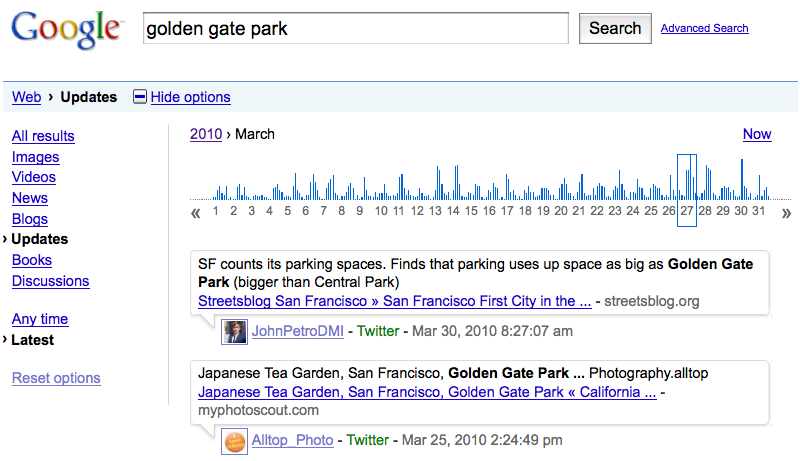
In related news, Stone announced a partnership with Google, introducing a new service called Google Replay. Replay “lets you relive a real time search from specific moments in time” with Tweets. In addition to viewing Tweets in an archived digital database at the Library of Congress, Replay is another “new way to revisit tweets related to historic events.” Right now the service only goes back a few months, but Stone promises it will eventually be able to access Tweets since Twitter’s inception in 2006. Google is rolling out the feature right now, and it will be made available globally within the next few weeks. For now, Google Replay can be accessed here. Try it out! Search a specific keyword and experience how events relating to it unraveled in time with Tweets.
[Via TwitterBlog; GoogleBlog]

NASA and General Motors are collaborating to send a robot to the International Space Station to aid the human astronauts who reside there. Sure we’ve sent robots into space before; you’ve heard of the Mars Rover, right? This is different. Robonaut 2, nicknamed R2, is preparing to become the first humanoid robot to enter space. It’s got arms, legs, a body, and head. R2 looks like one of us. So what’s it going to do up there? According to The New York Times, it “will be monitored in space to see how it performs in weightlessness, but NASA hopes to eventually use R2 to assist astronauts during space walks and to work alongside engineers in the space station.” R2 is scheduled to leave for space via the Space Shuttle Discovery in September. To infinity and beyond, I say! Look after the break for a video that takes you behind the construction of R2.
Continue reading NASA and GM are sending world’s first humanoid into space

This is an awesome sliver of news coming from the business world. NASDAQ and the Consumer Electronics Association have teamed up to announce NASDAQ OMX CEA Smartphone Index. The new index is comprised of 84 companies “that are primarily involved in the building, design and distribution of handsets, hardware, software, and mobile networks associated with the development, sale and usage of smartphones.” The smartphone industry has certainly become an important and impactful industry as of late; receiving its own index in the stock market further cements its significance thus far in the world of technology. Some of the companies in the index include Apple, Google, and Research in Motion (RIM). It was given a starting value of 250.00 on April 12; today it currently sits at 257.14.
[Via MarketWatch; Engadget]
Thanks to state of the art 3D technology, classic pieces of art can now be analyzed to reveal what’s been hiding behind them for so many years.
[Via Gizmodo]
A bunch of bright minds at the Hasso Plattner Institute in Germany have been working on this research project they call “multi-toe interaction.” Basically it’s a multitouch floor that can recognize a person based on their shoe pattern. But I’ll let the masterminds explain:
The key factor of the shown design is that it is based on frustrated total internal reflection sensing. FTIR allows it to identify and track users based on their sole patterns. The floor recognizes foot postures, distinguishes users who interact from people walking by, and enables high-precision interaction. In addition, the floor can approximate users’ head positions based on the pressure profile in the soles and it extracts enough details from soles to allow users to play first person shooters by balancing their feet.
So precise! Not so sure if this can ever be practically implemented, but it’s always good to see unique implementations of a multitouch interface. Even if it involves stinky feet.
One Ryan Hoagland has a created a DIY virtual window of sorts using two 46-inch Panasonic plasma displays, a Mac Pro workstation, a Wii-mote with a custom-built IR-emitting necklace, Bluetooth, and custom software called Winscape. If everything is implemented correctly, it should result in two large virtual windows that could theoretically project any scene you’d like. And thanks to headtracking technology, the windows will create an illusion that you are actually peering inside this virtual realm. Oh, and you can control scene selection with an iPhone app. Intruiged? You can build one of your own virtual landscapes come this July when Hoagland plans to sell basic kits for under $3000. Look after the break for a timelapse video of its construction.
[Via RationalCraft; Engadget]
Continue reading A virtual window into a scene you wish lived outside your home
IBM’s Smarter Planet campaign acknowledges the importance of intelligent systems in the world today. In the retail industry, for example, consumer data around something as simple as color can have massive implications around shipping, inventory and, ultimately, overall sales. This interactive billboard is a simple and engaging virtual demonstration of how a smarter retail system can work.
In other words, IBM is trying to make retailers and consumers alike recognize the importance of technology in the retail industry. Imagine, if you will, a world where when you walked into a Gap clothing store, a digital personal assistent recognized you by what you were wearing and helped you pick out a new season of clothes based on previous choices and personal taste. Yeah, that’s what IBM is going for here.
[Via Gizmodo]

“Shall we play a game?”
That’s the eerie question this aged personal computer asked David Lightman (Matthew Broderick) in the classic 1983 film WarGames. The IMSAI 8080 is the computer Broderick used to connect to the defense department’s W.O.P.R. supercomputer. He thought he was playing a game about global thermonuclear war, but in reality he was bringing the world ever so close to nuclear devastation. The IMSAI 8080 has been perfectly preserved since it was used as a prop in the movie. Currently appraised at over $25,000 it is about to be sold on the market. Whoever manages to win the Ferrari from Ferris Bueller should try to snag the IMSAI 8080 and create a next-generation KITT. Wouldn’t that be something? Check out a recent photograph of the device after the break.
Lin Yu Chun was a contestant on Super Star Avenue, a Taiwanese talent show. People call him the next Susan Boyle; he’s got that same “how is that voice coming from that body” experience that Boyle shared with the world on Britain’s Got Talent with “I Dreamed a Dream.” Chun’s performance of Whitney Houston’s classic love song “I Will Always Love You” made this guy an Internet sensation. I mean, just watch it! (I am aware this is a few weeks old now, but I just couldn’t let it go unnoticed.)
