Category Archives: Technology

Boy Scouts can now earn video games badges

The Boy Scouts of America recently announced the addition of two new badges scouts can earn, and they both involve video gaming!  The belt loop is awarded by “explain[ing] why it is important to have a rating system for video games”;  “creat[ing] a schedule for you to do things that includes your chores, homework, and video gaming”; and “learn[ing] to play a new video game that is approved by your parent, guardian, or teacher.”  Earning the academics pin is a bit more involved.  Scouts must “create a plan to buy a video game that is right for [their] age group”; compare and contrast two game consoles; play a video game with a family member and friend; teach an adult how to play a video game; come up with tips on how to play a game; play a game that practices a skill that helps with schoolwork; decide the best place to purchase a game; and install a game console.  Man, if they had these badges back in the day I would have been inaugurated as the first scout to pick them up.

[Via Scouting]

3D input interface brings Project Natal-style gestures to a cell phone

Researchers at the University of Tokyo have created an advanced motion-tracking camera that is designed to attach to a mobile device like a cell phone.  It allows for “in-air typing” or Project Natal-style gestures to type out text messages or emails by detecting finger movement.  The demo above shows how something like this could replace a physical and touch (virtual) keyboard on mobile devices.

[Via Ishikawa-Komuro Lab; Gizmodo]

Cable Woman

Connected, by Kasey McMahon.

Connected is a life-size self portrait sculpture created by artist Kasey McMahon.  It’s made entirely of CAT5 ethernet cables and other kinds of wire wrapped around a steel frame.  This modern piece of art is thought-provoking, isn’t it?  What do you think is the artist’s intent with it?  A splintered identity wrapped in digital culture, perhaps.  See the sculpture from different perspectives in the gallery below.

[Via AtypicalArt; Gizmodo]

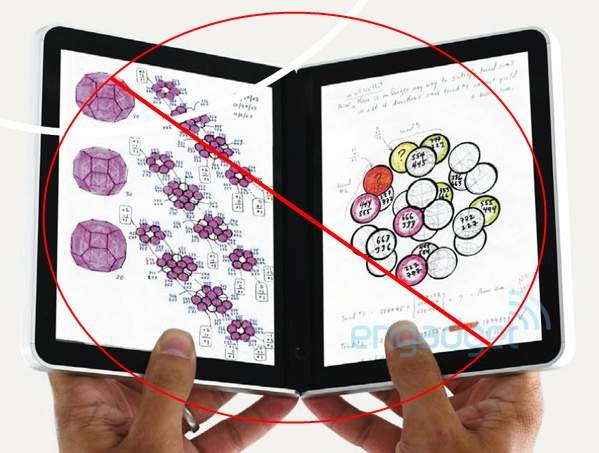
The Microsoft Courier is no more

At any given time, we’re looking at new ideas, investigating, testing, incubating them. It’s in our DNA to develop new form factors and natural user interfaces to foster productivity and creativity. The Courier project is an example of this type of effort. It will be evaluated for use in future offerings, but we have no plans to build such a device at this time. – Frank Shaw, Microsoft Corporate VP of Communications

And just like that, Microsoft confirmed and, unfortunately, denied the Microsoft Courier.  Back in September Gizmodo broke news that Microsoft had a magical tablet of sorts in the works; pictures and even a video of the prototype device had found its way into the mainstream.  Then came October and November, and those months brought more leaked video and images.  Then as recent as last month hard details surfaced; this “digital journal” running an advanced varient of Windows Phone 7 with enhanced UI features like dragging, flicking, copy & pasting, and “pocket”-ing all of a sudden started to come alive.  And then the words of Frank Shaw shut it all off.  The Microsoft Courier, the future proto-tablet that could, ceased to become a reality.

According to sources close to the matter Microsoft did hire an internal team to work on the Courier and there were actual plans to tranform it into a marketable device.  However, Microsoft just recently ordered Team Courier to close up shop.  Reasons, unknown.  Although the Courier prototype we’ve come to know and love thanks to a slew of leaked renders is dead and gone, all is not for naught.  We may very well see the innovative user interface deisgn come to fruition in some other Microsoft project(s) in the works.  But it’s a shame, really.  Microsoft–you had something BEYOND AWESOME with this thing!  Oh well, Windows Phone 7 will have to fill the void.

[Via Gizmodo; Endadget]

Steve Jobs shares his “thoughts on Flash” [Update: Adobe responds, Microsoft jumps in]

Apple CEO Steve Jobs released an open letter today regarding his position on Adobe’s Flash standard for video.  He breaks down his argument against Flash with the following categories: there’s “open”; the full web; reliability, security and performance; battery life; touch; and “the most important reason.”  That is, “If developers grow dependent on third party development libraries and tools, they can only take advantage of platform enhancements if and when the third party chooses to adopt the new features.”  Quick summation: Jobs calls Flash proprietary and closed; he shares his excitement on the rise of H.264 and the coming of HTML5; Flash makes Macs crash; since Flash decodes in software it eats away battery life; and Flash was not designed for a touch environment.  His concludes: 

Flash was created during the PC era – for PCs and mice. Flash is a successful business for Adobe, and we can understand why they want to push it beyond PCs. But the mobile era is about low power devices, touch interfaces and open web standards – all areas where Flash falls short.

But you should really read it for yourself, just look after the break.  Pretty compelling argument, eh?  Sure, H.264 and HTML5 are the future of video for mobile devices.  But Flash is in the here and now.  Ah, Jobs you’ve got me arguing for both sides now.  Form your own opinions in the comments below!

Update: Adobe CTO Kevin Lynch formally responded to Jobs’ open letter.  His short blog post is called “Moving Forward” but after reading it what he really means to say is moving past Apple.  Look after the break to see the rebuttal. Continue reading Steve Jobs shares his “thoughts on Flash” [Update: Adobe responds, Microsoft jumps in]

Apple’s WWDC set to begin June 7

Once a year Apple holds its World Wide Developers Conference in San Fransisco.  It’s a time when Apple opens its arms to the developer community and allows them to dip their feet into growing services like Mac OS X, iPhone OS 4, and now the “first ever” iPad sessions.  In-depth sessions and hands-on working labs provides developers a place to converse with Apple engineers about their apps and other software.  Oh, and it’s also the place where Steve Jobs takes the stage and presents the next iPhone!  (Well, he’s done it the past three years with iPhone, 3G, & 3GS, so I’d place a bet the rumored ‘iPhone HD’ will make an appearence.)  WWDC kicks off June 7 and runs through the 11th.  You can be sure to check back here for the latest developments that come from the event.  Look after the break for the official PR.

[Via Apple] Continue reading Apple’s WWDC set to begin June 7

Blackberry OS 6.0 revealed at WES 2010

At this year’s Wireless Enterprise Symposium (WES), Research in Motion (RIM) showed off the latest BlackBerry OS in video form.  (Go acronyms! Anyway…)  RIM CEO Mike Lazaridis did not go into detail about “BlackBerry 6” but he did have these choice words to say: “It’s an all-new user experience guided by a few fundamental design principles.  It had to be easy to use, yet incredibly powerful.  It had to be fun and approachable.  Anyone that looks at it should say ‘I want a BlackBerry.'”  He also shared his excitement about the “all-new WebKit browser.”  According to a leaked report from BGR, BB 6 will feature a new home screen (with customizable icons), the WebKit browser (with tab support), a redesigned media player and photo viewer, and a bunch of new keyboard commands.  It’s expected that BB 6 will natively support multitouch, finding a home both on touch and non-touch screen devices.  RIM confirms it will release later this year.

Also introduced at the event: the new BlackBerry Bold 9650 & BlackBerry Pearl 3G.  Sprint formally announced it will sell the new Bold for $199.99 with a new two-year contract; Verizon Wireless is expected to make a similar offer.  The Pearl 3G is heading to Canada first on Bell, Telus, and Rogers.  Peek after the break for an image of the sleek new pair of handsets.

[Via Gizmodo; Engadget; The Street] Continue reading Blackberry OS 6.0 revealed at WES 2010

HP acquires Palm; tech world goes “Gasp! Now what?”

On Wednesday HP announced its plans to buy out Palm for $1.2 billion, or at a price of $5.70 per share of Palm common stock.  This is big news, and it’s quite shocking.  Palm’s existance takes the shape of a rollercoaster ride.  Since its inception in 1996, Palm introduced the world to some of the first personal device assistants (PDAs) with the Palm Pilot, the Handspring Treo, Treo and Centro smartphones, and the failed experiment that was Folio.  After nearly facing its demise, Jon Rubinstein (who helped invent the iPod) left Apple to help ressurect Palm.  And so he replaced Ed Colligan as CEO, created a new mobile operating system called WebOS, and pushed out two new smartphones, the Palm Pre and Palm Pixi.  Thanks to a downright scary marketing campaign (watch this commercial if you dare) and tough business decisions (making the Pre exclusive to Sprint), Palm’s stock took another nosedive and rumors of a buyout quickly surfaced.  Tech companies like HTC and Lenovo sat at the top of analyst’s lists as possible companies to gobble up Palm.  And then, all of a sudden, HP  literally came out of no where to seal the deal.  And look at that, we’ve made it to present day.

HP will officially acquire Palm during HP’s third fiscal quarter, or by July 31.  So what does this mean for the two entities?  Right now this is what Palm’s got: the Pre, the Pixi, and most important to HP, WebOS.  HP’s executive VP Todd Bradley says, “Palm’s innovative operating system provides an ideal platform to expand HP’s mobility strategy and create a unique HP experience spanning multiple mobile connected devices.”  Essentially, HP is going to take everything WebOS and run with it across a wide range of devices.  Which means you can plan to see it running on smartphones and potentially netbooks and tablets.  All this begs the question, what will become of the HP Slate now that WebOS is on the table?  Only time will tell.

It’s been confirmed that Palm CEO Jon Rubinstein will stay onboard with the majority of senior team members at the company.  Also, the current Palm hardware roadmap has not been affected by the merger.  All signs point a happy marrige.  Says Rubinstein: “We look forward to working with HP to continue to deliver industry-leading mobile experiences to our customers and business partners.”  He added, “I don’t think HP would do this unless they were willing to make the kind of investment necessary to win.”  What’s interesting here, though, is that HP signed up to be an initial key partner with Microsoft for Windows Phone 7.  Also, HP already has their less-than-successful line of iPaq smartphones.  Will Palm become iPaq or stay Palm?  All of these questions will likely be answered sometime between now and July.  All in all, the acquisition is a big win for consumers (and Palm, really) as it will breath new life into the emerging WebOS platform and introduce new hardware on a whole new scale of innovation.

Look after the break for the official PR and a letter written by Rubenstein to his company.

[Via Engadget, here & here; WSJ] Continue reading HP acquires Palm; tech world goes “Gasp! Now what?”

Bungie announces 10-year “exclusive partnership” with Activision

Today Halo developer Bungie announced a partnership with Call of Duty publisher Activision.  To be more specific, it’s a “10-year exclusive [worldwide] partnership to bring Bungie’s next big action game universe to market.”  This means that for the foreseeable future, Activision will retain exclusive rights to publish all the games related to whatever Bungie has in store for us (a new Halo trilogy, perhaps?).  Also noteworthy, the announcement states that Activision also has the rights to distribute these games “on multiple platforms and devices”, meaning Bungie might finally cut its exclusive ties with Microsoft.  The partnership keeps Bungie an independent company and Bungie devs will continue to own their intellectual property.  Over at Bungie.net the devs share their excitement: “We are still Bungie, still independent, and now we are free to bring our stories to an ever bigger audience.”  With powerhouse titles under their belts, hopefully this unexpected partnership will result in some exciting new games for all major platforms.  Call of HaloHalo DutyGuitar Halo?  Sorry, I had to do it.

Look after the break for the official PR statement and a word from Bungie.

[Via Joystiq; Bungie] Continue reading Bungie announces 10-year “exclusive partnership” with Activision

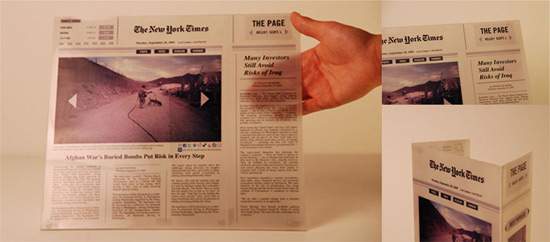
Concept: Foldable E-Ink newspaper display

The Page, designed by Jae Kim.

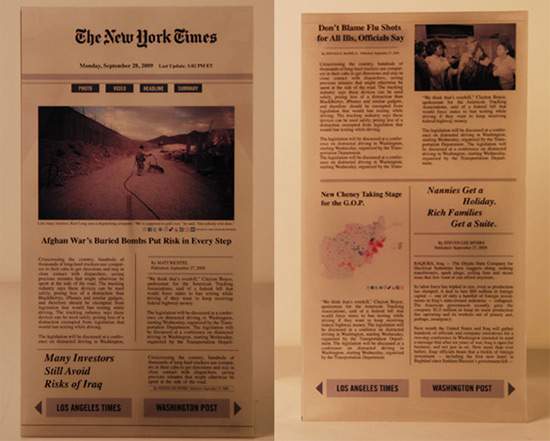
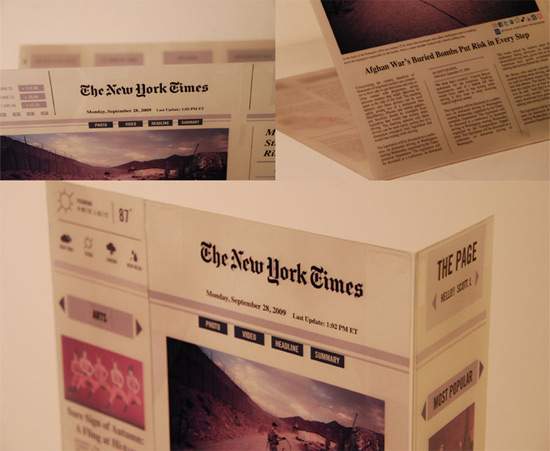
With all the buzz surrounding iPad this and iPad that, it’s nice to see someone else thinking outide the box when it comes to reinventing the way we read newspapers and other print media.  Designer Jae Kim has conceptualized The Page, a foldable display that features a semi-transparent E-Ink screen that displays text and images.  Screens that can bend into various shapes and sizes have been conceptually implemented in the past, so this certainly isn’t the first player to the game.  However, it does feature a number of interesting UI enhancements, including automatic column formatting depending on its shape and interactive page navigation on a flat surface.  Check it out in all its concept-y glory in the video above.  There’s some stills waiting below, too.

[Via Designboom; Gizmodo]